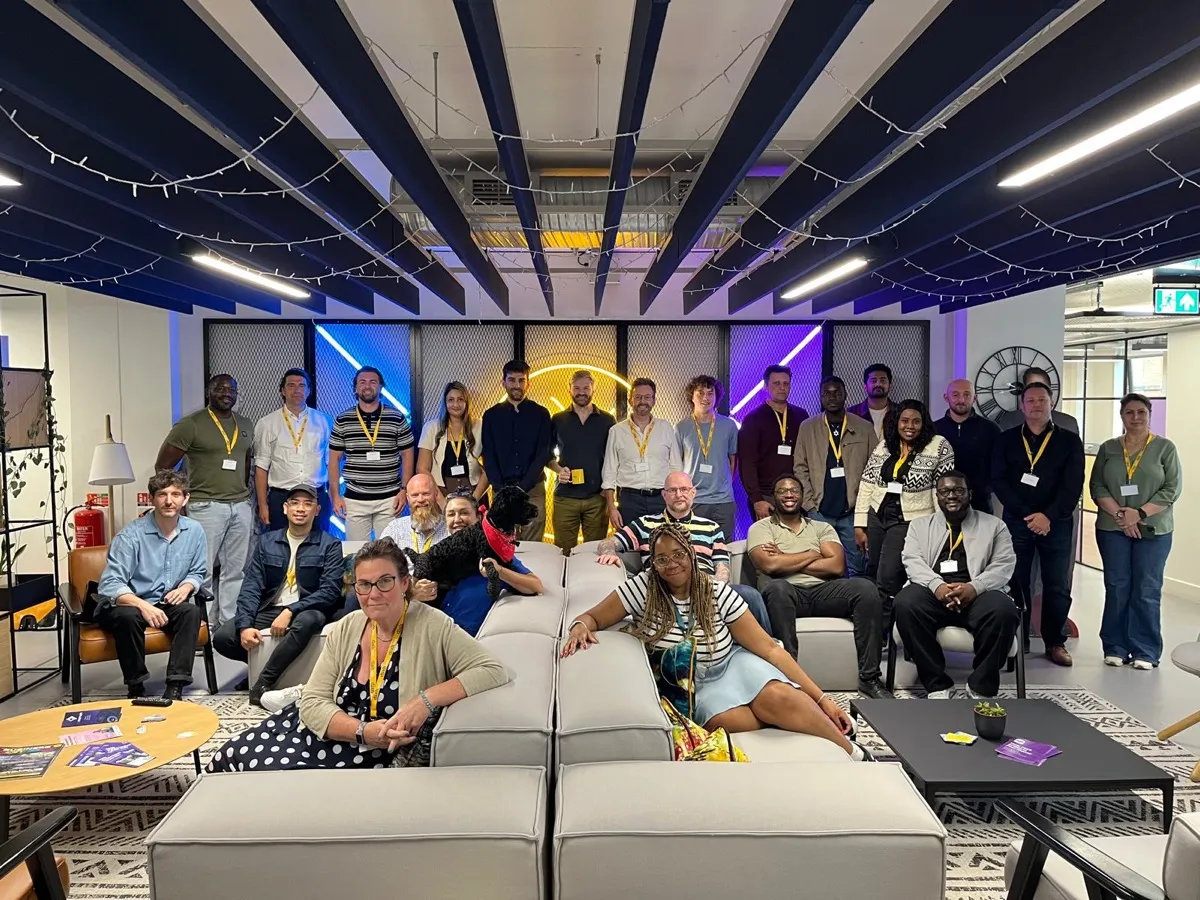
We are proud to announce that InnerWarden has been selected for the 7th cohort of the Digital Security Hub (DiSH) Accelerator, one of the UK's leading cybersecurity startup programmes.
Over the next three months we will be working alongside an outstanding ecosystem, including the consortium behind DiSH, Barclays Eagle Labs, Plexal, Lancaster University and The University of Manchester, and the wider UK cyber innovation ecosystem. For a company building runtime security for AI coding agents, it is hard to imagine a better place to do it.
What the DiSH Accelerator is
DiSH, the Digital Security Hub, is Greater Manchester's dedicated cybersecurity innovation centre, based at Heron House in the heart of Manchester. It was created by a consortium including Plexal, Barclays Eagle Labs, Lancaster University and The University of Manchester, with a stated ambition to support 500 startups and help create more than 1,000 jobs across the region.
The DiSH Accelerator itself is a three-month programme for early-stage companies, designed to accelerate business growth while strengthening cyber posture and resilience. Cohort members attend in person one day a week and get a genuinely practical mix of support: business masterclasses on digital, cyber and operational strategy, one-to-one mentoring with growth and cyber resilience experts, coaching to sharpen sales and investment pitches, investment-readiness support, and facilitated introductions to the industry, investors and government organisations across the UK cyber landscape.
Why being selected matters
AI coding agents have gone from a curiosity to a daily tool inside engineering teams in the space of a year. They read repositories, run shell commands, touch production systems and act on data they were never meant to trust. That makes the runtime, what the agent actually does on the host, the layer that matters, and it is exactly the layer InnerWarden defends.
Being selected for a programme of this calibre is a strong signal that the problem we are working on resonates with the people who build, fund and regulate cybersecurity in the UK. Just as importantly, it plugs a young company into an ecosystem it could not assemble on its own: enterprise security leaders, investors, world-class academic researchers and public-sector partners, in one place, over three focused months. For a security product, that kind of grounded, in-the-room feedback is worth more than almost anything else.
The partners, and how they contribute
The strength of DiSH is the breadth of the ecosystem behind it. Each partner brings a distinct kind of support:
- Barclays Eagle Labs: the delivery engine and business-growth backbone, connecting startups with mentors, investors and enterprise networks.
- Plexal: cyber innovation specialists who run the accelerator programme and open doors across the national security ecosystem.
- Lancaster University: one of the UK's foremost cyber security research institutions, bringing academic depth and research collaboration.
- The University of Manchester: world-class computer science and security research, plus access to exceptional engineering talent.
Together with the wider UK cyber innovation ecosystem that DiSH plugs into, they form the kind of cross-sector coalition, industry and academia, that a security company genuinely needs around it.
What InnerWarden plans to achieve
Our goals for the three months are concrete. We want to accelerate product development on the parts of InnerWarden that matter most to teams adopting AI agents, connect with enterprise security leaders, investors, researchers and government organisations, and expand our presence in the UK cybersecurity market, all while staying true to what InnerWarden is: a self-hosted, open-core runtime guardrail that keeps control of the machine, not a cloud service that watches from the outside.
The accelerator gives us the room and the network to test those ambitions against real feedback from the people who will ultimately decide whether a runtime guardrail for AI agents earns a place in their stack.
Enterprise customer validation
We will be honest about where we are: InnerWarden is early. The product is technically substantial and running in real production on our own infrastructure, but our next milestone is external validation, teams other than us running it against real AI-agent workloads.
That is precisely what the accelerator's enterprise introductions are for. Over the cohort we are looking for a small number of design partners, security and platform teams already deploying AI coding agents, who want a runtime guardrail around them and are willing to shape the product with us. If that is you, this is the best possible moment to get involved: early enough to influence the roadmap, with the product mature enough to run today.
Academic collaborations
Two of DiSH's founding institutions, Lancaster University and The University of Manchester, sit among the UK's strongest cyber security research communities. InnerWarden's foundations are research-shaped already: kernel-level eBPF detection, behaviour-based kill-chain correlation, and on-device machine learning for triage. The chance to put that work in front of serious academic researchers, and to draw on their expertise and talent, is one of the parts of this programme we are most excited about.
Runtime security for autonomous agents is a genuinely new research frontier. We would rather build it in the open, alongside the people studying it, than in isolation.
Public-sector engagement
As a Greater Manchester cyber programme sitting inside the UK's wider cyber innovation ecosystem, DiSH is also a route into the national conversation on cyber policy. As AI agents start to touch government and critical-infrastructure systems, the question of how you keep them under control stops being academic. We are keen to contribute to that conversation, and to help the UK's cyber innovation ecosystem stay ahead of a threat surface that is changing faster than most defences.
Our roadmap over the next three months
The programme sharpens the roadmap we were already on. Over the cohort we will focus on:
- Hardening the AI-agent guardrail: the layers that sit outside the agent, MCP inspection, the command-screening API and the fail-closed pre-execution hook, so a compromised or tricked agent still cannot cross the line.
- Maturing the Execution Gate: the kernel allowlist that refuses to run unknown binaries around an agent's process, moving from safe self-service arming toward smoother fleet-scale operation.
- Multi-tenant and fleet readiness: attributing agent activity to the right tenant and making InnerWarden easy to run across many hosts and Kubernetes nodes at once.
- Deeper agent integrations: first-class support for the coding agents teams actually use day to day.
- Enterprise readiness: the auditability, reporting and compliance posture that security buyers need before they will trust a new tool in production.
Thank you, and here is to the journey ahead
To the DiSH team and everyone across Barclays Eagle Labs, Plexal, Lancaster University and The University of Manchester: thank you for backing us. Being chosen for the 7th cohort is a genuine privilege, and we do not take it lightly.
We are building runtime security for the age of AI agents, and we get to do it inside one of the best cyber ecosystems in the UK. We could not be more excited for the road ahead. If you are a security leader, investor, researcher or fellow builder who cares about keeping AI agents under control, we would love to talk.